
What to Know About Choosing a Board-Certified Surgeon for Breast Augmentation
Choosing a board-certified surgeon for breast augmentation requires verifying credentials, understanding the scope of certification, and evaluating surgical experience. Board certification is a formal credential that confirms a surgeon has completed accredited training and passed rigorous examinations. At Careaga Plastic Surgery in Miami, Dr. Daniel Careaga provides personalized guidance to help patients navigate this critical decision with confidence and clarity. For additional details, review the 508 Resource Limit Is.
Understanding the Meaning of Board Certification
Board certification is a voluntary credential that verifies a surgeon has completed an accredited residency program and passed comprehensive examinations. It is not a license to practice medicine, but rather a mark of advanced training and commitment to professional standards. The American Board of Plastic Surgery (ABPS) is the primary certifying body for plastic surgeons in the United States, recognized by the American Board of Medical Specialties (ABMS). For additional details, review the Frequently Asked Questions.
Many patients confuse board certification with board eligibility or board affiliation. Board eligibility means a surgeon has completed residency but has not yet passed the board exams. Board affiliation is a marketing term that has no official standing. Only board certification confirms that a surgeon has met the highest standards of training and examination. This distinction is crucial when evaluating potential providers for breast augmentation. For additional details, review the About.
At Careaga Plastic Surgery, the emphasis on board certification reflects a commitment to patient safety and quality outcomes. Patients are encouraged to verify credentials directly through the ABPS website to ensure the surgeon they choose holds active, current certification.
Verifying Credentials Through Official Resources
Verification is the most important step in choosing a board-certified surgeon. The ABPS maintains a public directory where patients can search for certified plastic surgeons by name, location, and specialty. This directory confirms whether a surgeon is currently certified, when their certification was granted, and if any disciplinary actions have been taken.
Patients should also verify that the surgeon is licensed by the state medical board where the procedure will be performed. In Florida, the Florida Board of Medicine maintains a public license lookup tool. A surgeon may hold board certification but have a lapsed or restricted state license, which would prevent them from legally performing surgery. Checking both credentials ensures the surgeon is fully qualified and in good standing.
Dr. Daniel Careaga at Careaga Plastic Surgery encourages patients to take an active role in verifying credentials. This transparency builds trust and ensures patients are making informed decisions about their surgical care.
Evaluating Surgical Experience and Specialization
Board certification confirms foundational training, but surgical experience determines outcomes. Patients should ask how many breast augmentations a surgeon performs annually and what percentage of their practice is dedicated to breast surgery. A surgeon who performs hundreds of breast augmentations each year will have refined techniques and a deeper understanding of potential complications.
Specialization matters. Some plastic surgeons focus on general cosmetic procedures, while others specialize in breast surgery. A surgeon with a dedicated breast practice will be more familiar with the latest implant technologies, surgical approaches, and aesthetic techniques. Patients should review before-and-after photos, read patient testimonials, and ask about complication rates to gauge a surgeon's expertise.
At Careaga Plastic Surgery, Dr. Careaga brings extensive experience in breast augmentation, offering patients a range of implant options and surgical techniques tailored to their individual anatomy and aesthetic goals.
The Role of the Surgical Team and Facility
Board certification applies to the surgeon, but the quality of care also depends on the surgical team and facility. Patients should ask where the procedure will be performed and whether the facility is accredited by a recognized body such as the Accreditation Association for Ambulatory Health Care (AAAHC) or the Joint Commission. Accredited facilities meet strict standards for safety, infection control, and emergency preparedness.
The surgical team, including anesthesiologists, nurses, and technicians, should also be qualified and experienced. Patients should ask about the credentials of the anesthesiologist and whether they are board-certified in anesthesiology. A well-coordinated team reduces the risk of complications and ensures a smoother recovery process.
Careaga Plastic Surgery operates in a state-of-the-art facility that meets all accreditation standards, providing patients with a safe and comfortable environment for their breast augmentation procedure.
Key Takeaways
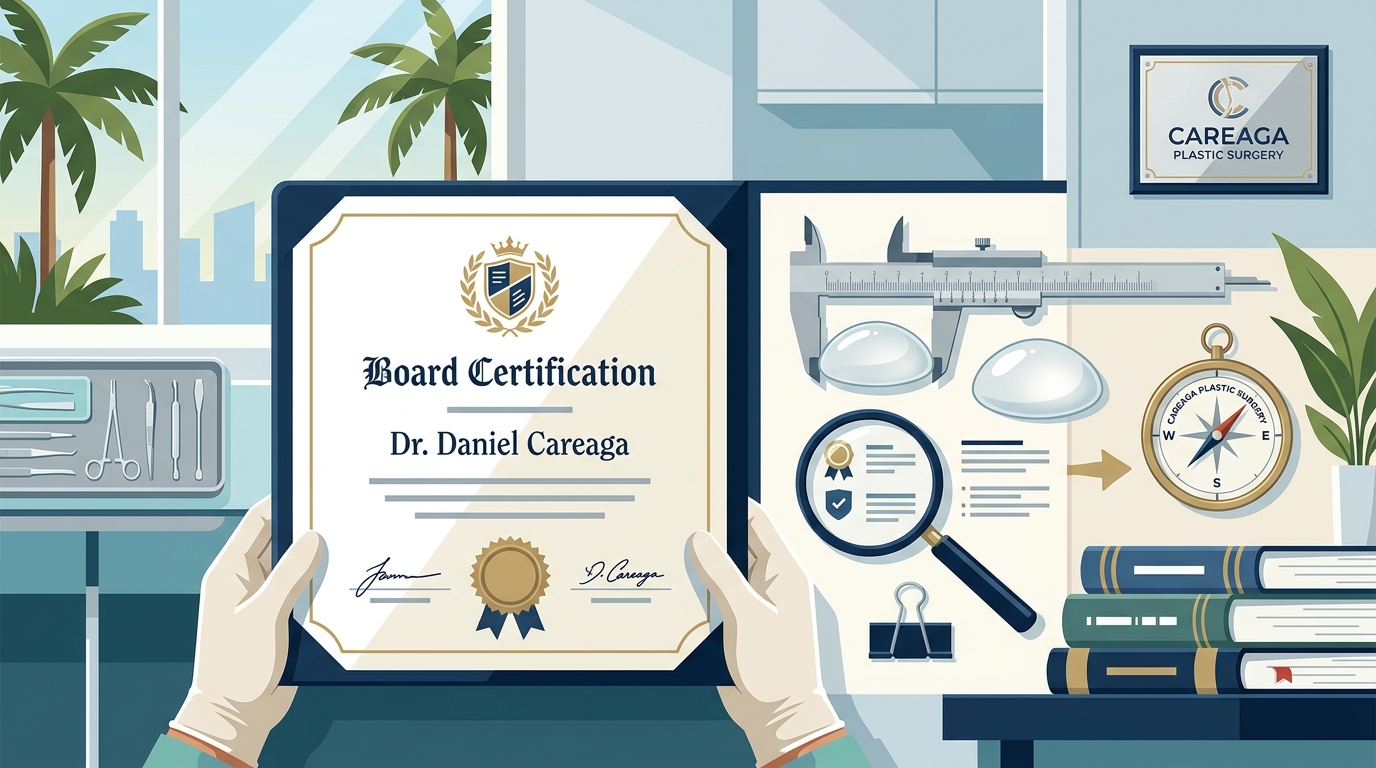
- Board certification is a voluntary credential that confirms a surgeon has completed accredited training and passed rigorous examinations.
- Verify credentials through the American Board of Plastic Surgery directory and the state medical board.
- Distinguish between board certification, board eligibility, and board affiliation to avoid misleading marketing terms.
- Evaluate surgical experience by asking about annual case volume and specialization in breast surgery.
- Ensure the surgical facility is accredited by a recognized body such as the AAAHC or Joint Commission.
- Ask about the credentials of the entire surgical team, including the anesthesiologist.
- At Careaga Plastic Surgery, Dr. Daniel Careaga provides personalized guidance to help patients make informed decisions.
Frequently Asked Questions
What is the difference between board certification and board eligibility?
Board certification means a surgeon has completed accredited residency and passed board examinations. Board eligibility means a surgeon has completed residency but has not yet passed the exams. Only board certification confirms the highest level of training and examination.
How can I verify if a surgeon is board-certified?
You can verify board certification through the American Board of Plastic Surgery (ABPS) public directory. You can also check the state medical board license lookup tool to confirm the surgeon is licensed and in good standing.
Is board certification required to perform breast augmentation?
Board certification is not legally required to perform breast augmentation, but it is the gold standard for quality and safety. Patients should strongly prefer board-certified plastic surgeons to ensure they receive care from a surgeon with the highest level of training and examination.
What should I ask a surgeon about their experience?
Ask how many breast augmentations the surgeon performs annually, what percentage of their practice is dedicated to breast surgery, and what their complication rates are. You can also review before-and-after photos and read patient testimonials to gauge their expertise.
Where should my breast augmentation be performed?
Your breast augmentation should be performed in an accredited surgical facility, such as one accredited by the Accreditation Association for Ambulatory Health Care (AAAHC) or the Joint Commission. These facilities meet strict standards for safety and infection control.
Who should be part of my surgical team?
Conclusion
Choosing a board-certified surgeon for breast augmentation is a critical decision that requires careful research and verification. By understanding the meaning of board certification, verifying credentials through official resources, evaluating surgical experience, and ensuring a safe surgical environment, patients can make informed decisions about their care. At Careaga Plastic Surgery in Miami, Dr. Daniel Careaga is committed to providing personalized, compassionate care to help patients achieve their aesthetic goals with confidence and safety.